Building the Rules:
The Historical Evolution
of Australian Building
Regulation & the NCC
From colonial fire ordinances to NCC 2025 — a 20,000-word definitive history for building surveyors, engineers, construction lawyers, architects, and serious students of the built environment.
Table of Contents
Why Building Codes Matter in Australia
The rules that govern the construction of buildings are among the most consequential pieces of technical and legal infrastructure in any modern society. They determine whether the structures in which people sleep, work, heal, and gather will remain standing in an earthquake, resist fire long enough for occupants to escape, admit sufficient daylight for human health, and endure the particular climatic stresses of their location.
In Australia, these rules have evolved over more than 160 years — from fragmented colonial ordinances that addressed little more than the fire risk of thatched roofs in densely settled colonial towns, through to the sophisticated, performance-based National Construction Code (NCC) that today governs every aspect of building and plumbing construction across the continent. Understanding this evolution is not merely an academic exercise. It is essential for any practitioner — building surveyor, architect, structural engineer, construction lawyer, or plumber — who must interpret, apply, or challenge the provisions of the code in day-to-day professional practice.
1.1 The Purpose of Building Regulation
At its most fundamental level, building regulation exists to protect people from the consequences of decisions made by others. A person purchasing or renting a home has no realistic way to assess whether its structural system will perform adequately under wind or seismic loads, whether the fire-rated construction between their apartment and their neighbour’s will contain a fire long enough for evacuation, or whether the insulation within its walls will prevent the formation of condensation that might compromise indoor air quality. Regulation substitutes expert-defined minimum standards for the market judgement of uninformed individuals.
The purposes of building regulation in Australia, as they have developed over time and as articulated within the framework of the NCC, encompass six broad categories. Safety is the primary and most longstanding concern — ensuring that buildings do not collapse, that fires are detected, contained, and survived, and that electrical and plumbing services do not create hazards. Health encompasses ventilation, damp control, acoustic separation, and, increasingly, the management of condensation and indoor pollutants that affect the respiratory and psychological wellbeing of occupants. Amenity encompasses those aspects of building performance that, while not directly life-threatening, materially affect the quality of life of occupants — natural lighting, thermal comfort, and acoustic privacy between neighbouring dwellings.
Sustainability has emerged as a major regulatory concern only in the last two decades, reflecting both the enormous energy consumption of the built environment — Australia’s buildings account for approximately a quarter of national energy use — and the policy imperative to reduce greenhouse gas emissions in line with international commitments. Accessibility ensures that buildings can be used by people of all physical capabilities, a concern that was largely absent from early building regulation and that has grown in sophistication and scope since the 1990s. Finally, economic efficiency is a recurring theme: well-calibrated building regulation reduces the long-term costs of building ownership and operation, avoids costly remediation of defects, and supports a well-functioning construction industry by providing clear, predictable rules.
1.2 The Uniqueness of Australia’s Federal System
The regulation of buildings in Australia is shaped in distinctive and sometimes complicating ways by the country’s federal constitutional structure. Under the Australian Constitution, the powers of the Commonwealth (federal) government are limited and enumerated; responsibility for matters not expressly granted to the Commonwealth — including the regulation of building construction — falls to the states and territories under their reserved legislative powers. This means that, as a matter of strict constitutional law, building regulation is a state and territory function.
The practical consequence of this division is that Australia has never had, and still does not have, a single national building Act. The NCC is not itself legislation; it is a model code — a technical document — that acquires legal force only when given effect by the building legislation of each state and territory. This distinction is critically important for practitioners and has been a source of significant complexity throughout the code’s development.
The federal system creates at least three kinds of complication. First, adoption of each new edition of the NCC requires a separate legislative or regulatory act in each of the eight state and territory jurisdictions, resulting in varying effective dates and occasional local modifications that can undermine national consistency. Second, enforcement mechanisms differ between jurisdictions, meaning that the practical effect of nominally identical NCC provisions may vary depending on where a building is located. Third, the policy decisions embedded in the NCC must be negotiated between nine governments — the Commonwealth and eight states and territories — and multiple industry interests, a political process that can slow reform and create compromise outcomes that satisfy no one fully.
Despite these complications, the establishment of a single national building code covering the overwhelming majority of Australian construction represents one of the most significant achievements of intergovernmental cooperation in the country’s regulatory history. The story of how that code came to exist — and how it has been refined and expanded over more than three decades — is the subject of this article.
1.3 Overview of the NCC as the Current Unified Code
The National Construction Code (NCC) is Australia’s primary set of technical requirements for the design and construction of buildings, structures, and plumbing and drainage systems. It is published by the Australian Building Codes Board (ABCB), a body jointly established by the Commonwealth and state and territory governments. The NCC is updated on a three-year cycle, with each edition designated by year — NCC 2019, NCC 2022, and NCC 2025 being the most recent editions at the time of writing.
The NCC is organised into three volumes. Volume One addresses Class 2 to Class 9 buildings — that is, multi-residential buildings such as apartment towers, as well as commercial, industrial, public, and institutional buildings. Volume Two addresses Class 1 and Class 10 buildings — houses, townhouses, and associated ancillary structures such as garages, carports, and sheds. Volume Three addresses plumbing and drainage systems for all building classes. This three-volume structure has been in place since 2011, when the code was renamed from the Building Code of Australia (BCA) to its present designation, reflecting the integration of plumbing regulation into a previously building-only framework.
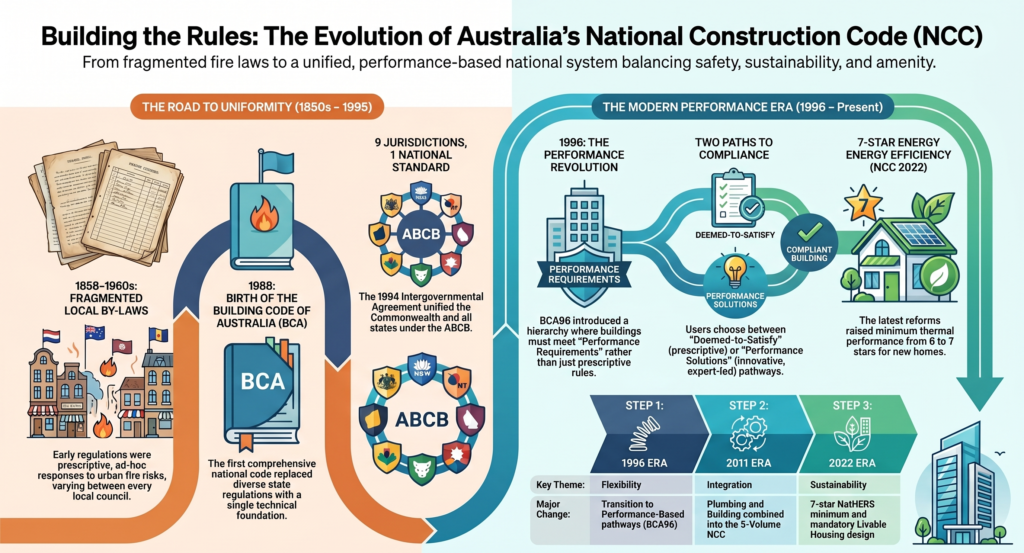
The NCC operates on a bifurcated compliance pathway that is one of its most distinctive and sometimes misunderstood features. A building is compliant with the NCC if it either follows the Deemed-to-Satisfy (DtS) provisions — prescriptive technical requirements that, if followed, are deemed by the code to satisfy the underlying performance objectives — or if it adopts a Performance Solution (formerly called an Alternative Solution) that demonstrates, through appropriate evidence, that the building meets the NCC’s Performance Requirements to an equivalent or better standard. This performance-based framework, introduced in 1996, is the foundation of modern building regulation in Australia and will be examined in considerable depth later in this article.
The NCC does not exist in isolation. It operates in relationship with a large body of referenced Australian Standards — technical documents published by Standards Australia — which provide the detailed technical requirements for specific construction systems, materials, and processes. It also interacts with state and territory variations, local planning controls, and a range of other statutory instruments that together constitute the full regulatory framework for Australian construction. Understanding the NCC therefore requires understanding the system within which it sits, not merely the document itself.
This article traces the full historical arc of Australian building regulation, from the earliest colonial efforts to regulate construction in the new settlements of the nineteenth century, through the gradual emergence of national coordination mechanisms in the mid-twentieth century, to the creation of the BCA and its transformation into the NCC. It examines the major thematic reforms that have progressively shaped the code’s content — fire safety, structural design, energy efficiency, accessibility, and sustainability — and considers the legal framework within which the code operates and the challenges and opportunities that face Australian building regulation in the years ahead.
Pre-BCA Era: Colonial and Early Federation Controls
To understand where Australia’s building regulation system has arrived, it is necessary to understand where it began — in the improvised fire ordinances, municipal by-laws, and fragmented state regulations of the colonial and early federation periods.
The history of building regulation in Australia is inseparable from the history of fire. The earliest and most urgent motivation for regulating construction was not structural safety, accessibility, or energy performance, but the catastrophic fire risk posed by densely settled colonial towns built predominantly of timber, with thatched or shingle roofs, open fires for cooking and heating, and no organised firefighting capability. The first regulatory interventions in Australian building construction were therefore concerned overwhelmingly with controlling the materials and configurations that made fire so devastating in the new settlements.
2.1 Early Ad-Hoc Colonial Ordinances and Fire Controls
From the earliest years of European settlement in Australia, colonial governors exercised sweeping executive powers over virtually every aspect of the fledgling settlements, including the construction of buildings. In New South Wales, Governor Arthur Phillip’s original instructions gave him broad authority to govern the settlement, and this authority was exercised through a variety of proclamations and orders that addressed building matters in an ad-hoc and reactive way. As the settlement at Sydney Cove grew from a collection of tents and wattle-and-daub huts into a more permanent town, the need for some degree of building control became apparent — though the mechanisms for exercising it remained primitive for many decades.
The first serious attempt at systematic building regulation in New South Wales came with the Towns Police Act 1833 and subsequent local legislation that gave town authorities the power to regulate building lines, prevent obstruction of public ways, and require the removal of dangerous structures. These were reactive and largely reactive powers — concerned with maintaining public order and preventing immediate hazards — rather than proactive quality standards for new construction. The fire risk of timber construction was nonetheless acknowledged in some early colonial regulations, which required brick chimneys in place of the timber and mud hearths common in simpler structures, and which sought to prohibit the use of thatch in urban areas.
As the population of Australian cities grew rapidly during the gold rush era of the 1850s, the inadequacy of these ad-hoc controls became increasingly apparent. The rapid expansion of Melbourne and Sydney — and the proliferation of speculative construction of timber cottages, terrace houses, and commercial premises — created densely settled areas in which fire could spread with devastating speed. Several major urban fires in the mid to late nineteenth century, resulting in the loss of substantial portions of commercial districts, focused political attention on the need for more systematic building regulation.
Victoria, galvanised by the rapid growth of Melbourne following the 1850s gold rush, was among the first jurisdictions to develop more systematic building legislation. The Local Government Act 1863 (Victoria) gave municipal councils extensive powers to make by-laws for the regulation of buildings, including requirements relating to materials, construction methods, drainage, and sanitation. In practice, these powers were exercised inconsistently across different councils — the by-laws of one municipality might require brick construction for buildings above a certain height, while an adjacent municipality imposed no such requirement. The result was a fragmented regulatory landscape in which the quality and safety of construction depended significantly on location.
In New South Wales, the Local Government Act 1858 similarly empowered councils to regulate building construction, and the City of Sydney developed its own building by-laws that were, for their time, relatively sophisticated. Requirements for minimum wall thicknesses, chimney construction, drainage, and sanitary facilities reflected a growing understanding of the relationship between building design and public health — an understanding that had been powerfully advanced by the sanitary reform movement in Britain, whose influence on Australian regulatory thinking was pervasive throughout the nineteenth century.
2.2 The Role of Local Government By-Laws and Prescriptive Town-Planning Rules
Throughout the late nineteenth and early twentieth centuries, the primary vehicle for building regulation in Australia was the local government by-law. Each municipal council had the power — and in many cases the obligation — to develop its own set of building requirements, which it could enforce through its building inspectors and, in cases of non-compliance, through the courts. The content of these by-laws varied enormously between jurisdictions, even within a single state.
The prescriptive character of these early regulations was their most defining feature. They specified not the performance outcomes that buildings were required to achieve but the precise methods and materials through which construction was to be executed. A by-law might specify that external walls of buildings above two storeys must be constructed of brick not less than 230 millimetres thick, that roof coverings must not be of combustible materials within a defined distance of a building line, or that stairways must not exceed a specified gradient. Such prescriptive rules had the virtue of simplicity and easy enforcement — an inspector could measure a wall thickness or check a roof material without requiring any specialist knowledge of fire dynamics or structural engineering — but they had the significant disadvantage of ossifying construction practice and preventing the adoption of new materials and methods that might have achieved better outcomes at lower cost.
The prescriptive character of early building regulation also reflected a historical moment in which the technical capacity for performance-based analysis simply did not exist. Fire engineers, structural engineers with expertise in limit-state design, and acoustic consultants were not available to evaluate proposed buildings against performance criteria; the scientific understanding of building performance that underlies modern codes had not yet been developed. Prescriptive rules were therefore both a practical necessity and a reflection of the state of technical knowledge at the time.
At the state level, some efforts were made to provide uniformity by publishing model by-laws or regulations that local councils were encouraged — though rarely compelled — to adopt. The states also progressively assumed direct regulatory responsibility for certain aspects of building construction, particularly those with direct public health implications such as drainage and sanitation, where the consequences of inadequate regulation extended beyond the boundaries of individual properties and into the public realm.
By the early twentieth century, most Australian states had enacted some form of state building legislation, supplemented by the local government by-law system. New South Wales, for example, operated under a framework in which the Local Government Act provided the enabling power for council by-laws, while state regulations addressed specific technical matters such as structural loading requirements and fire separation. This was a system of considerable complexity, in which a builder operating across multiple council areas or multiple states faced a bewildering diversity of requirements.
2.3 The Fragmentation Problem and Its Impact on Industry
The consequences of this regulatory fragmentation were felt most acutely by those involved in the construction industry itself. A national contractor — or, by the mid-twentieth century, a national manufacturer of building products — faced the practical reality of different technical requirements in different jurisdictions, making it impossible to design a single product or system that would meet all requirements simultaneously without the expense of adapting to local variations.
For architects and engineers, the fragmentation meant that expertise developed in one jurisdiction was not necessarily transferable to another. The building surveyor or certifier who had thoroughly mastered the building regulations of metropolitan Melbourne might find that those regulations differed in important respects from those applying in regional Victoria, let alone in New South Wales or Queensland. Professional education and continuing professional development had to address this complexity, or — as was too often the case — practitioners simply proceeded on the assumption that rules they knew applied in all jurisdictions, with potentially non-compliant results.
Perhaps most significantly, the fragmentation of building regulation acted as a barrier to productivity improvement and innovation in the construction industry. A manufacturer who had developed a new building system — a prefabricated facade panel, an innovative structural connector, or a new type of insulation — might find that the system was accepted in some jurisdictions and rejected in others, either because it fell outside the prescriptive provisions of local by-laws or because local certifiers were unfamiliar with the product and reluctant to accept it. The cost of seeking approval in multiple jurisdictions was a significant deterrent to innovation, and the consequence was a construction industry that was slower to adopt new technologies than might otherwise have been the case.
“A manufacturer who had developed a new building system might find it accepted in some jurisdictions and rejected in others — the cost of seeking approval in multiple jurisdictions was a significant deterrent to innovation.”
The fragmentation problem was also associated with a form of regulatory arbitrage: the practice of locating or structuring construction activities to take advantage of more permissive regulatory requirements in particular jurisdictions. While this problem was less acute in building regulation than in some other areas of law — it is difficult to relocate a building to a more permissive jurisdiction — the inconsistency of requirements between adjacent councils within the same metropolitan area created real incentives to site developments just across the boundary from more demanding regulatory regimes.
These problems were well understood by industry participants by the middle of the twentieth century, and they generated sustained advocacy for national regulatory coordination. The argument for a national building code rested on several pillars: the efficiency gains from eliminating the costs of navigating multiple regulatory systems; the productivity benefits of a larger, more uniform market for building products and systems; the quality improvements that would flow from applying consistent minimum standards across the country; and the improved professional competence that would result from practitioners working within a single, well-articulated regulatory framework. These arguments would take several decades to translate into political action, but the direction of travel was clear well before the formal establishment of national coordination bodies in the 1960s and 1970s.
Towards Uniformity: AMUBC and Early National Coordination
The first serious and sustained attempt to address the fragmentation of Australian building regulation came in the mid-1960s, when governments and industry agreed that the costs of disunity were too great to ignore any longer.
3.1 Formation of ISCUBR in 1965
The Interstate Standing Committee on Uniform Building Regulations (ISCUBR) was formed in 1965 as the first formal mechanism for intergovernmental coordination of building regulation in Australia. Its establishment reflected a growing recognition at both the political and bureaucratic level that the existing system of fragmented state and local regulation was imposing unnecessary costs on the construction industry and impeding both productivity and quality.
ISCUBR brought together representatives of the building regulation authorities of the Commonwealth and each state and territory, with the objective of developing a set of uniform building regulations that could be adopted, in whole or in part, by all jurisdictions. The committee’s mandate was both ambitious and inherently constrained by the political realities of the federal system: it could recommend uniform approaches, but it had no power to compel adoption. Participation was voluntary, and the ultimate decision about whether to adopt any proposed uniform provisions remained with each state and territory government.
The work of ISCUBR proceeded slowly, reflecting both the technical complexity of the task — building regulation encompasses an enormous range of subjects, from structural loading to drainage to fire compartmentation — and the political sensitivities involved in asking state governments to cede effective regulatory control to a national body. Progress was also constrained by resource limitations: the committee operated with modest secretariat support, and the work of drafting uniform provisions fell largely on officials who had primary responsibilities for administering their own state’s building regulations.
Despite these constraints, ISCUBR represented an important conceptual breakthrough. It established the principle that national coordination of building regulation was both desirable and feasible, and it created a working relationship between the relevant officials of different jurisdictions that would prove essential to the later development of more ambitious national coordination mechanisms. The committee also began the technical work of analysing areas of divergence between different states’ regulations and developing proposed uniform approaches — work that would eventually find expression in the Australian Model Uniform Building Code.
For practitioners: ISCUBR’s formation in 1965 is not merely a historical footnote. The committee’s work established the technical vocabulary — the classification of buildings by occupancy, the concept of fire resistance levels, the framework of structural loading requirements — that was subsequently inherited by the BCA and is still visible in the structure of the NCC today. When you read NCC Volume One and encounter the building classification system (Class 1 through Class 10), you are encountering a framework whose conceptual origins lie in the work of ISCUBR more than fifty years ago.
3.2 The Australian Model Uniform Building Code (AMUBC)
The principal product of ISCUBR’s work was the Australian Model Uniform Building Code (AMUBC), the first edition of which was published in the mid-1970s. The AMUBC represented a significant achievement: for the first time, Australia had a comprehensive model building code — covering structural design, fire safety, health and amenity, means of egress, and access — that had been developed through a genuine process of intergovernmental and industry collaboration and was intended for adoption across all jurisdictions.
The AMUBC was a prescriptive code in the tradition of the state and local regulations it was intended to replace and rationalise. Its provisions specified, in considerable technical detail, the requirements that buildings were to meet — wall thicknesses, floor fire resistance ratings, stair dimensions, ventilation rates, and so on. The prescriptive approach was deliberate: it allowed straightforward implementation and enforcement without requiring the level of specialist technical expertise that a performance-based approach would demand of certifiers and local councils.
The AMUBC was organised around a classification system for buildings that divided the building stock into classes based on occupancy and use — an approach directly influenced by similar classification systems in American and British codes. This classification approach recognised the fundamental insight that different building uses create different risks and impose different demands on occupants, and that regulatory requirements should be calibrated accordingly. A hospital, in which some occupants may be unable to evacuate without assistance, presents radically different fire safety challenges from a warehouse staffed only during business hours; a residential building occupied around the clock presents different energy efficiency challenges from an office building used primarily during daytime hours.
In practice, the AMUBC achieved only partial adoption. States and territories used it as a reference — incorporating many of its provisions into their own regulations — but few adopted it wholesale. Local modifications, additions, and omissions meant that the regulatory landscape remained fragmented even after the AMUBC’s development. Nonetheless, the AMUBC served an important coordinating function, establishing a common technical vocabulary and a common set of reference points around which the regulatory systems of different jurisdictions could be compared and progressively harmonised.
Subsequent editions of the AMUBC refined and expanded the original code, incorporating new technical knowledge about structural performance, fire behaviour, and health and amenity. The AMUBC’s development process also served as a practical school for the officials and practitioners who participated in it — a process of collaborative technical work that built the relationships and mutual understanding necessary for the more ambitious national coordination efforts that would follow.
3.3 The Australian Building Regulations Coordinating Council (AUBRCC)
The establishment of the Australian Building Regulations Coordinating Council (AUBRCC) in 1980 marked the next step in the evolution of national building regulation governance. AUBRCC was established at the ministerial level — bringing together the ministers responsible for building regulation in each jurisdiction, rather than just their officials — reflecting a recognition that progress on regulatory harmonisation required political commitment, not just bureaucratic coordination.
AUBRCC’s mandate was broader than ISCUBR’s. In addition to overseeing the continued development and maintenance of the AMUBC, the council was tasked with providing strategic direction for the harmonisation of Australian building regulations, including the identification of priority areas for reform and the development of policy positions on emerging issues. The elevation of coordination to the ministerial level also gave the process greater authority and visibility, signalling to the construction industry and the building professions that national harmonisation was a genuine political commitment rather than merely a bureaucratic aspiration.
Under AUBRCC’s stewardship, the process of transforming the AMUBC into a more authoritative national code accelerated. Technical working groups examined specific areas of the code — structural design, fire safety, energy efficiency — and developed more sophisticated and comprehensive provisions. The growing technical capacity of the building professions, including the increasing availability of specialist fire engineers, structural engineers, and building scientists, provided a resource base for more rigorous technical development work.
AUBRCC also grappled with the fundamental question of what form a national building code should take. The AMUBC was a model code — a document that states and territories could adopt but were not required to — and the inconsistency of adoption had produced the familiar patchwork of partially harmonised regulations. AUBRCC began exploring whether it might be possible to create a more authoritative form of national code, perhaps through intergovernmental agreement, that would be adopted uniformly across all jurisdictions. This exploration laid the groundwork for the development of the Building Code of Australia in 1988 and the establishment of the ABCB in 1994.
Birth of the Building Code of Australia
The first edition of the Building Code of Australia, published in 1988, was a landmark event in Australian regulatory history — the first time the nation had a single, comprehensive national building code applicable in principle to all construction across the country.
4.1 The First Edition of the BCA (1988)
The Building Code of Australia (BCA) was first published in 1988, the culmination of more than two decades of intergovernmental coordination work under ISCUBR and AUBRCC. The BCA represented a substantial departure from the model code approach of the AMUBC: it was intended from the outset to be adopted as the uniform national building code across all Australian jurisdictions, replacing — or providing the technical foundation for — the diverse state and local regulations that had governed building construction for the preceding century and a half.
The 1988 BCA was still, at heart, a prescriptive code. Its provisions specified the technical requirements that buildings were to meet — fire resistance levels, structural loading requirements, minimum ventilation rates, and so on — without offering practitioners the explicit flexibility of performance-based alternatives. In this respect it resembled its predecessors: the innovation lay not in its technical philosophy but in its scope and its ambition for uniform national adoption.
The organisation of the BCA reflected the building classification framework developed through the AMUBC, with buildings divided into classes based on occupancy and use. The code was divided into a series of parts addressing different technical subjects — structure, fire resistance, egress, health and amenity, and so on — with detailed provisions for each class of building within each subject area. Referenced Australian Standards provided additional technical depth for specific construction systems and materials, establishing a model of code-and-standards interaction that has persisted through all subsequent editions of the BCA and NCC.
Adoption of the 1988 BCA by the various state and territory governments was not immediate or universal. The process of incorporating BCA provisions into state legislation and regulations took several years, and in practice different jurisdictions adopted different parts of the BCA at different times, with varying degrees of fidelity to the national document. State-specific additions and modifications persisted, and local government by-laws in some areas continued to impose requirements that were not fully aligned with the national code. The 1988 BCA was therefore an important milestone rather than an immediate achievement of full national consistency.
4.2 The Policy Drivers for a Single BCA
The political and economic context of the early 1990s accelerated the push for a more genuinely unified national building code. The Keating government’s commitment to microeconomic reform — and the related agenda of reducing regulatory barriers to interstate trade and investment — created strong policy pressure for the harmonisation of product and construction standards across the country. The construction industry, which had long advocated for regulatory uniformity, intensified its lobbying in this period, pointing to the costs imposed by the continuing fragmentation of building regulation as a concrete example of the kind of regulatory barrier that national competition policy was intended to eliminate.
The Council of Australian Governments (COAG), which became the primary vehicle for intergovernmental policy coordination in this period, identified building regulation as a priority area for reform. A Building Regulation Review Task Force was established to examine the existing system and make recommendations for improvement. The Task Force’s findings were damning: the existing regulatory framework was unnecessarily complex, inconsistent across jurisdictions, resistant to innovation, and costly to the industry. It recommended the establishment of a single national body responsible for developing and maintaining a genuinely national building code, with provisions that would be adopted uniformly across all jurisdictions.
The Task Force also identified the need to transition from a prescriptive code to a performance-based one. The prescriptive approach — specifying exactly how buildings were to be built rather than what performance they were to achieve — was identified as a major barrier to innovation and as a source of unnecessary costs. A performance-based code would specify the outcomes buildings were required to achieve and leave the means of achieving those outcomes to the judgement of designers, engineers, and builders, subject to appropriate professional assessment and verification. This approach was already being adopted in several comparable overseas jurisdictions, most notably New Zealand, and was seen as both technically superior and more conducive to productivity improvement.
| Period | Regulatory Model | Key Characteristics | Primary Driver |
|---|---|---|---|
| Pre-1965 | Fragmented local by-laws | Prescriptive; council-by-council; no national framework | Fire safety; public health |
| 1965–1987 | ISCUBR / AMUBC model | Model code; voluntary adoption; improving harmonisation | Industry productivity |
| 1988–1995 | BCA (prescriptive) | First national code; prescriptive; patchy adoption | Microeconomic reform |
| 1996–2010 | BCA96 (performance-based) | Performance requirements + DtS; annual cycle; ABCB oversight | Innovation; efficiency |
| 2011–Present | NCC (3-volume) | Building + plumbing integrated; 3-year cycle; free online | Sustainability; quality; consistency |
4.3 The BCA’s Relationship to State Regulation
A critical legal and practical question in the development of the BCA concerned its relationship to the pre-existing body of state building legislation and local government by-laws. The BCA could not, by itself, displace state legislation — it had no legislative authority of its own. Its authority derived entirely from the legislative acts by which each state and territory incorporated its provisions into their own legal framework.
The approach adopted in each jurisdiction varied somewhat, but the general model was for the state building Act to provide that buildings must comply with the BCA (and subsequently the NCC) as the technical standard, with state legislation addressing procedural matters such as the issuing of building permits, the conduct of inspections, and the enforcement of non-compliance. This model gave the BCA practical legal force while preserving the constitutional position that building regulation was a state function.
One practical consequence of this model was that state-specific modifications to the BCA were possible — states could add to or (in some cases) subtract from the national requirements through their own legislation or regulations. These state-specific variations were a persistent source of complexity for national contractors and product manufacturers, and a recurring concern of the ABCB in its mandate to promote national consistency. The process of reducing state variations has been an important, if incomplete, achievement of the ABCB over the years since its establishment.
State variations in practice: Even today, some state-specific requirements persist alongside the NCC. For example, Queensland maintains additional requirements relating to termite management that go beyond the NCC’s provisions. Victoria has historically applied its own energy efficiency and accessibility requirements at certain points in the NCC’s development cycle. New South Wales has specific requirements for apartment design quality under the Apartment Design Guide. Practitioners must always check both the NCC and the relevant state or territory-specific requirements for any given project.
The ABCB publishes a summary of state and territory variations on its website, but this should always be checked against current state legislation, as the position can change between NCC updates.
Creation of the Australian Building Codes Board (ABCB)
The establishment of the Australian Building Codes Board in 1994 was the institutional cornerstone of Australia’s national building regulation system — creating, for the first time, a permanent body with the mandate, resources, and authority to develop and maintain a genuinely national building code.
5.1 Background: The Building Regulation Review Task Force
The decision to establish the ABCB flowed directly from the recommendations of the Building Regulation Review Task Force, which had reported to COAG in the early 1990s. The Task Force had concluded that the fragmented governance of the existing building regulation system — with responsibility dispersed across Commonwealth, state, territory, and local government bodies, with no single entity responsible for national oversight and no permanent mechanism for developing and updating the national code — was a fundamental obstacle to achieving genuine national consistency.
The Task Force recommended the creation of a new body — jointly owned by the Commonwealth and the states and territories — that would be responsible for the development, publication, and maintenance of the national building code, and that would have the standing and resources to undertake this responsibility on an ongoing basis. This body would work in collaboration with industry, the building professions, and technical experts, drawing on the broad base of knowledge and experience required to address the full range of subjects covered by a comprehensive building code.
The Task Force’s recommendations were accepted by COAG, and negotiations between the Commonwealth and the states and territories produced the Intergovernmental Agreement that formally established the ABCB. The signing of this agreement in April 1994 marked the transition from the era of ad-hoc intergovernmental coordination to one of permanent institutional governance of national building regulation.
5.2 The Intergovernmental Agreement and the ABCB’s Powers
The Intergovernmental Agreement (IGA) of April 1994 is the foundational constitutional document of the Australian building regulation system. It is an agreement between the Commonwealth of Australia and each of the eight state and territory governments — not a piece of legislation, but a formal intergovernmental compact that established the legal and governance framework within which the ABCB operates.
The IGA defined the ABCB’s mandate as the development and maintenance of the BCA (subsequently the NCC) as Australia’s national building code, along with the promotion of national consistency in building regulation through the encouragement of uniform adoption of the code by all jurisdictions. The agreement also established the ABCB’s governance structure, funding arrangements, and accountability mechanisms.
The IGA gave the ABCB significant technical authority — the power to develop and publish the content of the national code — but it stopped short of giving the board binding legislative power over the states and territories. Adoption of the code by each jurisdiction remained a voluntary act, implemented through state and territory legislation. This preserved the constitutional integrity of the federal system while creating a framework within which the practical reality of national adoption could be pursued through political and administrative means.
5.3 Governance Structure, Funding, and Stakeholder Representation
The ABCB is governed by a board comprising representatives of the Commonwealth and each state and territory government, along with independent members drawn from industry and the building professions. The board’s composition reflects the joint ownership of the organisation and the importance of both government and industry perspectives in the development of the national code. The ABCB is supported by a professional secretariat based in Canberra, which manages the day-to-day operations of the organisation, coordinates the technical work of developing and maintaining the NCC, and engages with stakeholders through the consultation processes that are central to the code’s development.
Funding for the ABCB has been provided jointly by the Commonwealth and the states and territories, with the contribution of each jurisdiction broadly proportionate to the size of its construction industry and building stock. This joint funding model is essential to the ABCB’s independence from any single government — it cannot be directed unilaterally by the Commonwealth and must maintain the support of all participating jurisdictions to continue its operations. The practical consequence of this funding model is that major policy decisions — such as the decision to move to a performance-based code, or the decision to integrate plumbing regulation into the NCC — require genuine consensus across all participating governments, which can make significant reform a slow and sometimes frustrating process.
Industry engagement with the ABCB has been a consistent feature of the organisation’s work since its establishment. Technical committees responsible for different areas of the NCC — structural design, fire safety, energy efficiency, accessibility, and so on — include practitioners from the relevant industries alongside government officials and academic experts. Public consultation processes allow a broader range of stakeholders to comment on proposed changes before they are finalised. This engagement model reflects the understanding that a technically credible building code must be grounded in the practical experience of those who design, build, and certify buildings, not merely in the theoretical analysis of government officials.
5.4 The ABCB’s Mandate for Performance-Based Reform
From the outset, the ABCB’s mandate included the objective of transitioning the BCA from a prescriptive to a performance-based code. This was not merely a technical objective; it reflected a fundamental rethinking of the appropriate role of building regulation in a modern economy. A prescriptive code specifies how buildings must be built; a performance-based code specifies what buildings must achieve. The latter approach is more consistent with a market economy — it sets the standards that buildings must meet and leaves the means of meeting those standards to the creativity and judgement of the market — and more conducive to the adoption of new materials and technologies that may achieve better outcomes than those contemplated by the prescriptive rules.
The ABCB’s work in its first years was therefore directed substantially toward the development of BCA96 — the performance-based version of the BCA that would be published in 1996 and adopted across all jurisdictions from 1 July 1997 onwards. This work involved both the development of new performance requirements and the translation of existing prescriptive requirements into deemed-to-satisfy provisions — a form of prescriptive rule that, rather than being the only way to comply with the code, is presented as one way of satisfying the underlying performance requirement.
BCA96: The Performance-Based Revolution
The publication of the performance-based BCA in 1996 — known as BCA96 — was the most philosophically significant reform in the history of Australian building regulation. It fundamentally changed the relationship between the code and those who used it.
6.1 Influences and Development
The development of BCA96 drew heavily on international precedents, most notably the New Zealand Building Code introduced in 1992 under the New Zealand Building Act 1991. New Zealand had been a pioneer in performance-based building regulation, and its experience provided both technical insights and practical lessons about the implementation challenges of moving from prescriptive to performance-based regulation. The New Zealand code demonstrated that performance-based regulation was technically feasible — that it was possible to express building requirements as performance objectives and to develop verification methods that allowed certifiers to assess compliance without reducing the code to a set of prescriptive rules.
Australian regulatory officials and technical experts engaged extensively with their New Zealand counterparts during the development of BCA96, and several structural features of the New Zealand Building Code — in particular the distinction between performance requirements and verification methods — were adapted for the Australian context. The influence of New Zealand’s experience should not, however, be overstated: BCA96 was developed specifically for the Australian regulatory, technical, and professional context, and there are important differences between the two codes in both structure and content.
The United Kingdom’s approach to building regulation — which had been partially performance-based since the 1985 reforms — was also influential, as was the growing body of academic and professional literature on performance-based regulation more generally. The concept of performance-based regulation had received significant attention in the regulatory theory literature of the 1980s and 1990s, and the arguments for it — greater flexibility, more efficient use of resources, better accommodation of technological innovation — were well established by the time BCA96 was developed.
6.2 Key Features of BCA96
BCA96 introduced a three-tier regulatory structure that remains the foundation of the NCC today. At the top level are Objectives — broad statements of the goals that the code is intended to achieve, such as protecting occupants from injury or illness, conserving energy, and facilitating the equitable use of buildings. Below the Objectives are Functional Statements — more specific statements of what a building element or system must do to contribute to achieving the relevant Objective. At the third level are Performance Requirements — the actual technical standards that a building must meet, expressed in performance terms.
Against the Performance Requirements, BCA96 established two compliance pathways that have defined Australian building regulation ever since. The first — and most widely used — is the Deemed-to-Satisfy (DtS) pathway, under which a building element or system is deemed to comply with the relevant Performance Requirement if it is designed and constructed in accordance with the prescriptive provisions set out in the DtS section of the code. These DtS provisions are, in essence, the prescriptive rules of the old code, reclassified as one way of satisfying the performance requirement rather than as the only permissible approach. Following the DtS provisions is the straightforward path — the one taken by the vast majority of building projects — and it requires no specialist analysis or documentation beyond demonstrating that the DtS specifications have been followed.
The second compliance pathway is the Performance Solution (originally called the Alternative Solution). Under this pathway, a designer may propose a building element or system that does not follow the DtS provisions, provided they can demonstrate — through appropriate evidence, which might include expert judgement, quantitative analysis, physical testing, or some combination thereof — that the proposed solution meets the relevant Performance Requirements to an equivalent or better standard than the DtS approach. This pathway opened the door to genuine innovation in building design and construction: a system that did not exist when the DtS provisions were written, and therefore could not be incorporated into those provisions, could nonetheless be used if its performance could be demonstrated.
6.3 Adoption Timeline Across Jurisdictions
BCA96 was adopted across all Australian jurisdictions from 1 July 1997, though the process of adoption and the transition arrangements varied somewhat between jurisdictions. The Commonwealth — for buildings on Commonwealth land and in the Australian Capital Territory — adopted BCA96 on 1 July 1997. Most states adopted the new code at or around the same time, though some transitional arrangements allowed projects that had already commenced the design process under the earlier prescriptive code to complete under the old provisions.
The adoption of BCA96 was accompanied by significant industry education and training activity. The shift from a prescriptive to a performance-based code was not merely a change in regulatory philosophy; it represented a fundamental change in the nature of professional practice for building certifiers, architects, engineers, and other practitioners. In a prescriptive system, compliance is essentially a matter of checking whether the specified methods and materials have been used. In a performance-based system, compliance requires an understanding of what performance is required, an assessment of whether the proposed design will achieve that performance, and the documentation of that assessment in a way that can be reviewed by the certifier and, if necessary, by a court or tribunal. These are substantially more demanding professional activities than simple checklist compliance.
Common misconception — Performance Solutions vs DtS: A persistent misunderstanding in the industry is that Performance Solutions are a lesser or more risky form of compliance than DtS provisions. In fact, the opposite is often true. A carefully documented Performance Solution — supported by comprehensive engineering analysis, relevant physical testing, and the assessment of suitably qualified experts — may provide a far higher level of assurance about a building’s actual performance than a DtS solution that has been applied mechanically without regard to the specific conditions of the project.
The NCC is explicit: a building that complies with a properly documented Performance Solution is just as lawfully compliant as one that follows the DtS provisions to the letter. The challenge is in the documentation — the evidence of compliance must be sufficient to satisfy the relevant building surveyor or certifier, and ultimately a court if compliance is disputed.
6.4 Early Amendments to BCA96
The period from 1997 to approximately 2003 was one of active refinement of BCA96 through a series of amendments — Amendments 1 through approximately 12 — that addressed issues identified in the early implementation of the performance-based code. These amendments served several purposes: correcting errors or ambiguities in the original text, incorporating new technical knowledge, responding to industry requests for clarification, and addressing emerging issues not contemplated at the time the original code was drafted.
The amendment process revealed both the strengths and the limitations of the performance-based approach. On the positive side, the flexibility of the performance-based framework meant that it was possible to address new issues — new materials, new construction systems, new types of buildings — by adjusting the DtS provisions or adding guidance on Performance Solutions, without necessarily requiring changes to the fundamental Performance Requirements. On the negative side, the abstraction of the performance-based approach created genuine uncertainty in some areas, as certifiers and practitioners struggled to determine what evidence was sufficient to demonstrate compliance with performance requirements that were expressed in broad terms.
The early amendments also reflected the continuing evolution of technical knowledge and industry practice. Fire engineering, for example, was a rapidly developing discipline in the late 1990s, and the amendments to BCA96 progressively incorporated new approaches to performance-based fire safety design that had been validated through research and practical experience. Similarly, structural engineering practice was being refined through the progressive adoption of limit-state design methodologies that were more analytically rigorous than the allowable stress approaches they replaced, and these developments found expression in amendments to the structural provisions of the BCA.
6.5 Industry and Regulator Responses
The industry response to BCA96 was, in broad terms, positive — though not without significant reservations. The performance-based approach was welcomed in principle, particularly by the larger and more technically sophisticated end of the industry, where the flexibility to develop innovative solutions was of direct commercial value. However, the practical implementation of the performance-based approach created challenges at multiple levels of the industry.
For large commercial developers and their professional advisers, BCA96 opened genuine opportunities for design flexibility and cost optimisation. Performance Solutions in fire safety, for example, allowed designers to propose atria and open floor plate arrangements that would have been impossible under the prescriptive code, provided that a fire safety engineer could demonstrate that the proposed arrangement would achieve adequate evacuation performance. The growth of the fire engineering profession in Australia from the late 1990s onwards was directly stimulated by the opportunities created by BCA96.
For small builders and certifiers operating in the residential and light commercial sector, the performance-based approach was more challenging. The DtS provisions were typically the practical basis for compliance — most small projects could not justify the cost of a performance-based analysis — but the DtS provisions for residential construction were not always as comprehensive or as clear as practitioners needed. There were areas where the transition from the prescriptive provisions of the earlier code to the DtS provisions of BCA96 created gaps or ambiguities, and these were the source of the early amendments.
Regulators — particularly building surveyors and certifiers responsible for assessing compliance — faced perhaps the greatest adjustment. The role of a certifier in a prescriptive system is essentially an auditing function: checking whether the specified methods and materials have been used. In a performance-based system, the certifier must exercise genuine professional judgement about whether the proposed design — particularly where a Performance Solution is proposed — will actually achieve the required performance. This is a more demanding and more professionally exposed role, and the development of the skills and professional frameworks needed to discharge it effectively took time.
Annual BCA Cycle and Incremental Reforms (2004–2010)
From 2003, the BCA adopted an annual amendment cycle, transitioning from a code that was amended periodically through numbered amendments to one that was substantially republished each year with a new edition designation. This shift had significant implications for practitioners, regulators, and the industry as a whole.
7.1 The Annual Amendment Cycle
The decision to shift to an annual amendment cycle in 2003 — with new editions of the BCA taking effect from 1 May each year — reflected a recognition that the pace of technical and regulatory development in the building and construction industry required a more frequent update mechanism than periodic amendments to a stable base document. The annual cycle allowed the ABCB to be more responsive to emerging issues, new research findings, and changing policy priorities, and it aligned the BCA more closely with the update cycles of the Australian Standards referenced within it.
Under the annual cycle convention, editions were renamed to reflect the year of publication: BCA 2004, BCA 2005, BCA 2006, and so on. This naming convention — while straightforward — created practical complications for practitioners and industry participants who needed to determine which edition applied to a particular project. A building permit might be issued in one calendar year under the edition of the BCA operative at the time, while construction continued into subsequent years during which new editions had come into force. The question of which edition’s requirements applied to which aspects of the project was a recurring source of uncertainty.
The practical resolution of this issue varied between jurisdictions — some states provided explicit guidance on the applicable edition for projects in progress, while others left the matter to be resolved by reference to the date of the building permit or the commencement of construction. This inconsistency was itself a manifestation of the broader challenges of operating a national code through nine separate state and territory adoption mechanisms.
Applicable edition — a persistent practical issue: The question of which edition of the BCA (or NCC) applies to a particular project is one that still arises regularly in practice. The general principle in most jurisdictions is that the requirements of the code operative at the date of issue of the building permit apply to the entire project — subject to transitional arrangements that may apply to the commencement of a new edition. However, this general principle is subject to exceptions and qualifications in different jurisdictions, and practitioners should always confirm the applicable edition with the relevant building authority at the outset of each project.
7.2 Integration of Emerging Technical Themes
The annual BCA cycle from 2004 to 2010 saw the progressive integration of several important technical themes that had been identified as priorities for reform during the BCA96 period. These themes reflected both new technical knowledge and changing policy priorities, and their incorporation into the BCA represents the cumulative effect of a sustained programme of technical development work by the ABCB and its technical committees.
Fire engineering continued to develop as a discipline during this period, and successive BCA editions incorporated more sophisticated guidance on Performance Solutions for fire safety. The development of fire engineering verification methods — quantitative approaches to demonstrating that a proposed fire safety solution achieves the required performance — made it possible to bring greater rigour and consistency to the assessment of Performance Solutions in this area. The growth of the fire engineering profession, supported by the Fire Protection Association Australia and the academic community, provided the human capital necessary to undertake these analyses.
Accessibility became an increasingly prominent theme in successive BCA editions during this period, reflecting both the policy imperative created by the Disability Discrimination Act 1992 and the growing recognition that accessible buildings were not only a matter of legal compliance but of basic equity and inclusion. The BCA’s accessibility provisions were progressively expanded and refined, incorporating new requirements for accessible paths of travel, accessible toilets, wayfinding, and other features that facilitate the use of buildings by people with disabilities.
Energy efficiency emerged as a major new regulatory theme in the early 2000s, reflecting the growing policy emphasis on reducing the energy consumption of buildings as part of Australia’s response to climate change. The introduction of mandatory energy efficiency provisions for residential buildings in BCA 2006 — requiring compliance with the NatHERS (Nationwide House Energy Rating Scheme) rating tool or the DtS energy efficiency provisions — was a landmark development. Commercial buildings had somewhat earlier energy efficiency requirements, though these were less comprehensive than those introduced for residential buildings in subsequent editions.
Bushfire resilience attracted renewed regulatory attention following a series of devastating bushfire events in the early 2000s, particularly the Canberra bushfires of January 2003 that destroyed over 500 homes. The integration of the BCA’s requirements for buildings in bushfire-prone areas with the requirements of Australian Standard AS 3959 (Construction of Buildings in Bushfire-Prone Areas) was refined and strengthened, and subsequent events — including the catastrophic Victorian bushfires of February 2009 — prompted further regulatory responses that will be examined in more detail later.
7.3 The Interaction Between the BCA and Australian Standards
A distinctive and important feature of the BCA’s structure — established in the BCA96 era and continued through all subsequent editions — is its heavy reliance on referenced Australian Standards as the vehicle for embedding technical detail into the code. The BCA itself sets the performance requirements and the DtS framework; the detailed technical requirements for specific construction systems and materials are typically found in the referenced Standards.
This relationship between the BCA and Australian Standards operates through the mechanism of normative reference: a provision of the BCA that refers to an Australian Standard incorporates the requirements of that Standard as if they were part of the code itself. In practice, compliance with the referenced Standard is compliance with the relevant part of the BCA — and non-compliance with the Standard is non-compliance with the code.
The reliance on referenced Standards has significant practical implications. Australian Standards are commercial products — they are developed by Standards Australia and sold at commercial prices, which means that access to the full technical requirements of the BCA involves the cost of purchasing the relevant standards. The publication of the BCA (and subsequently the NCC) as a free online resource from 2015 partially addressed the access issue, but the referenced Standards themselves remain commercially priced, and the cost of a comprehensive Standards library can be significant for smaller practices.
The referenced Standards also have their own update cycles, which do not always align with the BCA/NCC annual or triennial update cycles. When a new version of a referenced Standard is published, the question of whether it applies — or whether the earlier version referenced in the current BCA/NCC edition continues to apply — requires careful analysis. The ABCB provides guidance on this issue, and the transition to the three-year NCC cycle has improved (though not eliminated) the alignment between NCC editions and the referenced Standards.
| BCA/NCC Edition | Key Technical Change | Theme | Impact |
|---|---|---|---|
| BCA 2004 | Strengthened egress requirements for residential buildings | Fire Safety | New smoke alarm requirements for Class 1 |
| BCA 2005 | Expanded accessibility provisions | Accessibility | New access requirements for Class 3 hotels |
| BCA 2006 | Mandatory residential energy efficiency | Energy | NatHERS / Section J introduced for Class 1 |
| BCA 2007 | Revised structural loading references | Structure | Updated AS 1170.2 wind actions |
| BCA 2009 | Post-Black Saturday bushfire reform | Bushfire | Stronger BAL requirements; updated AS 3959 |
| BCA 2010 | Expanded commercial energy provisions | Energy | Tightened Section J for Class 5/6/7/8/9 |
From BCA to NCC: Consolidation of Building and Plumbing (2011)
The renaming and restructuring of the Building Code of Australia into the National Construction Code in 2011 was more than a change of title. It represented the integration of building and plumbing regulation into a single national framework for the first time.
8.1 Rationale for the NCC
The decision to integrate plumbing and drainage regulation into the building code framework was driven by recognition that the two regulatory domains — building construction and plumbing and drainage systems — were closely interconnected in practice and that their separate regulation through different codes, administered by different bodies, created unnecessary complexity and potential for gaps and inconsistencies. Buildings cannot function without plumbing and drainage, and the design and installation of plumbing systems is deeply embedded in the construction process from the earliest stages of building design.
The separate regulatory frameworks for building and plumbing had evolved historically for understandable reasons: plumbing was, for most of Australian regulatory history, primarily a public health matter — concerned with ensuring safe water supply and effective waste removal — while building regulation was primarily a structural safety matter. The two professions — building surveyors and plumbing inspectors — had different skills, different training, and different regulatory frameworks. The growing recognition, however, that building performance encompassed all of the systems within a building — structural, fire, hydraulic, mechanical, electrical, and acoustic — made the case for a more integrated regulatory approach increasingly compelling.
The establishment of the NCC in 2011, with its three-volume structure, achieved this integration at the level of the national code document, though the administration and enforcement of plumbing regulation remains, in most jurisdictions, separate from building regulation and is carried out by different inspectors with different qualifications and different statutory powers. The NCC therefore represents a single national technical standard for both building and plumbing, but the administrative systems for ensuring compliance with that standard remain to a significant degree separate.
8.2 Structure of NCC Volumes One, Two, and Three
Volume One of the NCC addresses Class 2 to Class 9 buildings — the full range of multi-residential, commercial, industrial, and institutional buildings. It is the most extensive of the three volumes, addressing all aspects of building performance from structural design through fire safety, egress, health and amenity, energy efficiency, and accessibility. Volume One is the primary reference for practitioners working on apartment buildings, offices, hospitals, schools, shopping centres, warehouses, and most other non-residential building types.
Volume Two addresses Class 1 and Class 10 buildings — the houses, townhouses, and ancillary structures that make up the residential building stock. Volume Two is organised differently from Volume One, reflecting the particular characteristics of residential construction and the different professional and regulatory contexts in which residential building work typically occurs. Volume Two has historically relied more heavily on prescriptive DtS provisions — the span tables, material specifications, and construction details that builders and certifiers in the residential sector depend on as practical compliance tools.
Volume Three addresses plumbing and drainage systems across all building classes. It sets out the performance requirements and DtS provisions for water supply systems, sanitary plumbing, stormwater drainage, and other hydraulic services. Volume Three is referenced by the state and territory plumbing legislation in each jurisdiction, creating the same kind of relationship between the NCC technical standard and state-level enforcement that characterises the building volumes.
Which volume applies? Building class determines which NCC volume applies to a project — but building class is not always immediately obvious for mixed-use or complex developments. A building that contains retail on the ground floor (Class 6), commercial offices on mid-levels (Class 5), and residential apartments above (Class 2) is subject to different NCC Volume One provisions for each part. A detached dwelling with an attached garage is primarily Class 1 (Volume Two) with a Class 10a ancillary structure. The building classification framework — and the NCC provisions that flow from it — should be confirmed for every project at the earliest stage of design.
8.3 Implementation Challenges
The integration of building and plumbing regulation into the NCC was not without implementation challenges. The most significant of these concerned the coordination between building surveyors and plumbing inspectors — two professional groups with different training, different regulatory backgrounds, and different approaches to compliance assessment. The NCC provides a single technical standard, but its application in practice involves these two professional groups, whose interactions are not always well coordinated.
The recognition of plumbing as a genuine engineering discipline, with its own performance requirements and Performance Solution pathway, also required an adjustment in the professional culture of the plumbing industry. Like building surveying, plumbing inspection had historically been primarily a prescriptive compliance function — checking that specified materials and methods had been used — and the performance-based approach of the NCC required a more analytically demanding form of professional engagement.
NCC Lifecycle and Amendment Process
The process by which the NCC is developed, consulted on, finalised, and adopted is a sophisticated regulatory machinery that balances technical rigour, stakeholder engagement, and intergovernmental coordination in a federal system of government.
9.1 The Three-Year Update Cycle
Since the introduction of the three-year update cycle commencing with NCC 2016, the NCC has been published on a regular three-yearly schedule, with new editions designated NCC 2016, NCC 2019, NCC 2022, and NCC 2025. This shift from the earlier annual cycle — which had applied from 2003 to the period preceding NCC 2016 — was intended to provide greater regulatory certainty for the industry, reduce the compliance burden of annual code updates, and allow more time for the development and consultation processes that produce well-crafted, technically robust code provisions.
The three-year cycle begins well before the publication of each new NCC edition. Proposals for change are developed and assessed over a two-to-three-year period, during which they pass through multiple stages of technical review, economic analysis, public consultation, and political approval. The ABCB publishes a Regulatory Impact Statement (RIS) for significant proposed changes, which assesses the costs and benefits of the proposed reform and provides the analytical basis for the ABCB board and Building Ministers to make informed decisions about whether and how to proceed.
9.2 The Development Process
Proposals for changes to the NCC can originate from a wide range of sources: state and territory governments, industry bodies, professional associations, individual practitioners, researchers, and the ABCB’s own technical review processes. The ABCB maintains a register of proposals for change, which is publicly accessible and provides transparency about the issues under consideration for future NCC editions.
Once a proposal is accepted for consideration, it is allocated to the relevant technical committee or working group, which undertakes the detailed technical work of assessing the proposal, developing draft provisions, and considering how any proposed changes would interact with the existing code structure and with referenced Australian Standards. This technical work is done in close consultation with relevant industry stakeholders and specialists, and the drafts produced by technical committees undergo multiple rounds of internal review before being advanced to the public consultation stage.
The Public Comment period — a formal consultation process in which the proposed changes are published for public review and comment — is a critical element of the NCC development process. Any person or organisation with an interest in the proposed changes may submit comments, and the ABCB is required to consider and respond to all substantive submissions. This process ensures that the perspective of practitioners, industry participants, researchers, and members of the public are incorporated into the final code provisions, and it provides an important safeguard against changes that are technically flawed or that would impose unreasonable burdens on the industry.
Following the public comment period, the ABCB reviews the submissions, makes any necessary changes to the proposed provisions, and prepares the final NCC edition for consideration by the ABCB board and Building Ministers. Once approved by ministers, the new NCC edition is published and the process of adoption by state and territory governments begins. This adoption process, as noted earlier, requires a separate legislative or regulatory act in each jurisdiction, and the timing and completeness of adoption can vary.
9.3 State and Territory Adoption Practices
The adoption of each new NCC edition by state and territory governments is, as noted above, a necessary step for the new code provisions to have legal effect in that jurisdiction. The process of adoption varies between jurisdictions and can introduce delays that mean the nominal publication date of an NCC edition does not correspond to the date on which it becomes legally operative in all states and territories.
Some jurisdictions have adopted streamlined adoption mechanisms — automatic references to the current edition of the NCC in their building legislation — that reduce the administrative burden of adoption and minimise delays. Others require separate regulatory instruments for each new edition, which can introduce meaningful delays and create a period during which the newly published NCC edition has no legal force in that jurisdiction despite being publicly available.
State and territory variations — additions to or modifications of the NCC provisions that apply only within a particular jurisdiction — add another layer of complexity to the adoption process. These variations must be documented, communicated to practitioners, and given effect through appropriate legislative instruments. The management of state and territory variations is an ongoing concern of the ABCB, which seeks to minimise their number and scope in the interests of national consistency, while respecting the constitutional authority of states and territories to impose requirements beyond those in the national code where there is a genuine local rationale.
Major Thematic Reforms Over Time
The NCC is not a monolithic document but a living instrument whose content has evolved steadily in response to technical advances, disaster events, social policy changes, and environmental imperatives. This section traces that thematic evolution across seven major domains.
10.1 Fire Safety and Egress
Fire safety has been the oldest and most persistent concern of Australian building regulation. From the earliest colonial ordinances requiring brick chimneys and prohibiting thatched roofs in urban areas, through the development of fire resistance levels and compartmentation requirements in the BCA era, to the sophisticated performance-based fire engineering of the modern NCC, the regulatory response to fire risk has evolved from simple prescriptive prohibition to nuanced, risk-informed engineering assessment.
The conceptual framework for fire safety in the BCA and NCC is built around three fundamental principles: containment of fire to prevent its spread to uninvolved parts of the building; detection of fire at the earliest possible stage to allow evacuation to commence; and egress — the provision of adequate means of escape for all occupants. Each of these principles has been progressively refined and elaborated through successive code editions.
Fire resistance levels (FRL) — expressed as the minutes of structural adequacy, integrity, and insulation that a building element must maintain in a standard fire test — remain the central metric for containment. The FRL system, inherited from the prescriptive era and adapted for the performance-based BCA, specifies minimum FRLs for structural elements, walls, floors, and service penetrations based on the building’s Class and Type of Construction. The Type of Construction framework — Types A, B, and C, corresponding broadly to the level of fire resistance required — has been refined through successive BCA and NCC editions, with particular attention to the interface between structural fire resistance and external facade systems in the wake of the combustible cladding crisis.
The combustible aluminium composite panel (ACP) cladding issue — which crystallised in Australia following the Lacrosse Building fire in Melbourne in November 2014, and internationally following the Grenfell Tower fire in London in June 2017 — represents one of the most significant fire safety regulatory failures in Australian construction history. The rapid spread of fire up the external facade of these buildings, fuelled by combustible ACP cladding, exposed a critical gap in the regulation of external facade systems. The prescriptive DtS provisions of the BCA and NCC had not adequately addressed the risk of external fire spread on high-rise buildings, and the application of combustible cladding to thousands of buildings across Australia — often in compliance with the literal words of the applicable code provisions — had created a widespread systemic risk.
Automatic fire sprinkler systems have been required in progressively more building types and configurations through successive BCA and NCC editions. The evidence base for the effectiveness of sprinkler systems in preventing fire fatalities and limiting fire damage is overwhelming, and the BCA/NCC has progressively extended the circumstances in which sprinklers are mandatory. NCC 2022 requires sprinkler systems in all Class 2 (apartment) buildings above a certain height, in all Class 3 (hotels, hostels) buildings, and in many other high-occupancy building types. The extension of sprinkler requirements to lower-rise Class 2 buildings has been a subject of ongoing policy debate, with advocates pointing to the life-safety benefits and industry participants raising concerns about the cost implications for apartment construction.
Performance-based fire engineering has grown substantially in scope and sophistication since BCA96 opened the Performance Solution pathway. The discipline now encompasses computational fluid dynamics modelling of fire and smoke development, egress simulation, fire hazard analysis, and quantitative risk assessment — analytical tools that allow engineers to assess the fire safety of complex building configurations that cannot be addressed by the prescriptive DtS provisions. The growth of performance-based fire engineering has been accompanied by the development of professional standards, guidance documents, and verification frameworks that help to ensure the quality and consistency of fire engineering assessments across practitioners and projects.
10.2 Structural Design
The structural design provisions of the BCA and NCC have evolved from simple prescriptive requirements — specifying minimum wall thicknesses, maximum span tables, and basic material specifications — to a sophisticated framework that relies heavily on the suite of structural design Australian Standards, most notably the AS 1170 series (structural design actions, encompassing gravity, wind, snow, and seismic loads) and the material-specific design standards (AS 3600 for concrete, AS 4100 for steel, AS 3700 for masonry, AS 1720 for timber).
The shift from permissible stress design to limit state design — a fundamental change in structural engineering methodology that occurred progressively through the 1980s and 1990s with the introduction of successive Australian Standards — was one of the most significant technical reforms in the history of Australian construction. Limit state design, which assesses structural performance against defined limit states (ultimate collapse and serviceability), is more rational, more transparent, and more efficient in its use of materials than the earlier allowable stress approach. The integration of limit state design into the BCA through the referencing of revised Australian Standards was an important step in modernising Australia’s structural design framework.
The Newcastle earthquake of December 1989 — which killed 13 people and caused damage estimated at over $4 billion in today’s dollars — was a watershed event for Australian structural engineering regulation. The earthquake, which measured magnitude 5.6 on the Richter scale, struck a city that had been regarded as in a zone of negligible seismic risk, and exposed the vulnerability of buildings designed without adequate earthquake resistance. The regulatory response was the progressive strengthening of the earthquake design requirements referenced in the BCA and NCC, including the introduction of more rigorous seismic hazard maps and the extension of mandatory earthquake design provisions to areas previously regarded as low-risk.
10.3 Energy Efficiency and Sustainability
The integration of mandatory energy efficiency requirements into the BCA represents one of the most significant expansions of the code’s regulatory scope in its history, and the progressive tightening of those requirements in successive NCC editions reflects the growing urgency of Australia’s climate policy commitments. Energy efficiency regulation in the NCC is primarily concerned with reducing the energy consumption of buildings through improved thermal performance of the building envelope, more efficient artificial lighting, and the use of efficient heating, ventilation, and air conditioning (HVAC) systems.
Mandatory energy efficiency requirements were introduced for Class 5 and 9 (commercial) buildings in BCA 1999/2000, representing the first time that the BCA required buildings to achieve a minimum level of energy performance. These requirements were modest by later standards but established the important principle that energy performance was a legitimate regulatory concern — a significant shift from the historical focus of building regulation on structural safety and fire safety.
Requirements for residential buildings (Class 1 and 10) were introduced in BCA 2006, applying to all new houses and requiring them to meet a minimum thermal performance standard assessed either through the NatHERS rating tool (achieving a minimum star rating) or through compliance with the prescriptive DtS provisions of Section J of Volume Two. The initial residential energy requirements were relatively modest — a minimum 5-star NatHERS rating in most climate zones — but they have been progressively tightened through successive NCC editions.
NCC 2022 introduced a step-change in residential energy efficiency requirements, raising the minimum NatHERS rating for new homes to 7 stars (from 6 stars in most jurisdictions) and introducing new requirements for whole-of-home energy use that address the impact of appliances and renewable energy systems on total building energy performance. The 7-star requirement was accompanied by new DtS provisions that specified higher levels of insulation, better-performing windows, and reduced air infiltration compared to the previous edition. These changes reflected the growing policy ambition to reduce residential energy consumption and carbon emissions as part of Australia’s climate commitments.
Looking ahead, the NCC’s energy efficiency provisions are expected to continue to tighten in response to Australia’s net-zero emissions commitments. The concept of net-zero-energy buildings — buildings that generate as much energy as they consume over the course of a year — is increasingly influencing the direction of building energy policy, and future NCC editions are likely to progressively incorporate requirements that move the building stock in this direction. The integration of embodied carbon — the emissions associated with the manufacture and transport of building materials — into building environmental assessment is a likely future development, though one that presents significant methodological and practical challenges.
10.4 Accessibility and the Disability Discrimination Act Interface
Accessibility regulation in the NCC has its roots in the broader social policy agenda of the disability rights movement, which gained significant legislative expression in Australia through the Disability Discrimination Act 1992 (DDA). The DDA makes it unlawful to discriminate against a person on the grounds of disability in, among other areas, the provision of goods, services, and facilities — a category that encompasses access to buildings. The DDA does not specify technical standards for accessible buildings directly; rather, it creates a legal obligation to provide access that is reasonable in the circumstances, and compliance with the relevant Australian Standard for access (originally AS 1428.1 and its successor parts) is recognised as relevant evidence of reasonable compliance.
The BCA’s accessibility provisions have been progressively expanded since the early 1990s, adding requirements for accessible paths of travel, accessible sanitary facilities, accessible carparking, accessible lifts, and other features that facilitate the use of buildings by people with mobility impairments, vision impairments, and other disabilities. The pace of these expansions has at times been a subject of controversy: disability advocates have argued that the code’s requirements have not kept pace with the DDA’s non-discrimination mandate, while industry participants have raised concerns about the cost of compliance and the practical challenges of achieving accessibility in existing buildings and heritage-listed structures.
NCC 2022 introduced the most significant expansion of accessibility requirements in the code’s recent history, with the mandatory adoption of Livable Housing Design standards for new Class 1 dwellings. The Livable Housing Design requirements — which mandate a minimum level of accessibility in the design of new houses — had been the subject of sustained advocacy by disability organisations for many years, and their inclusion in NCC 2022 represented a major policy victory for the accessibility community. The requirements include provisions for step-free entry, wider doorways, reinforced bathroom walls capable of supporting grab rails, and a toilet on the entry level — features that make homes more usable for people with disabilities and more adaptable for older residents who may develop mobility limitations over time.
10.5 Health and Amenity
Health and amenity provisions in the NCC address those aspects of building performance that affect occupants’ physical and psychological wellbeing without directly creating fire or structural safety risks. This diverse group of requirements encompasses natural lighting, ventilation, damp management, acoustic separation, and — in more recent NCC editions — condensation management.
Condensation management emerged as a significant regulatory concern in the NCC 2019 and NCC 2022 editions, driven by the recognition that poorly detailed building envelopes — particularly in new residential construction — were experiencing significant condensation problems that could lead to mould growth, structural degradation, and adverse health impacts for occupants. The problem was exacerbated by the increased levels of insulation required by energy efficiency provisions (which create larger temperature gradients across the building envelope) and by the widespread use of vapour barriers installed incorrectly or in unsuitable locations. NCC 2019 introduced new requirements for condensation management in certain climate zones, and NCC 2022 expanded these requirements to address the issue more comprehensively.
Acoustic performance requirements — particularly for Class 2 and Class 3 buildings where occupants share walls, floors, and ceilings — have been a feature of the BCA/NCC since the early editions, but have been progressively refined and strengthened in response to growing evidence that poor acoustic performance in residential buildings has significant adverse effects on occupant wellbeing and satisfaction. The requirements reference the relevant acoustic testing standards and specify minimum Sound Transmission Class (STC) and Impact Isolation Class (IIC) ratings for party walls and floor/ceiling assemblies.
10.6 Bushfire Resilience and Climate Risk
The regulation of building construction in bushfire-prone areas has been an area of progressive regulatory reform since the catastrophic bushfire events of the 1980s and subsequent decades demonstrated the vulnerability of conventionally constructed buildings to ember attack and radiant heat. The regulatory response has been developed through the close interaction of the BCA/NCC with Australian Standard AS 3959 (Construction of Buildings in Bushfire-Prone Areas), which provides the technical basis for the code’s provisions in this area.
The AS 3959 Bushfire Attack Level (BAL) framework — which classifies building sites into BAL categories ranging from BAL-LOW (negligible risk) through BAL-12.5, BAL-19, BAL-29, and BAL-40, to BAL-FZ (flame zone, the highest risk category) — is the central tool for assessing the fire risk to a building site and determining the construction requirements that apply. Buildings in higher BAL categories are required to use non-combustible construction materials, ember-resistant openings, and other protective measures to improve their chances of surviving a bushfire event.
The Black Saturday bushfires of February 2009 — which killed 173 people across Victoria and destroyed over 2,000 homes — were the most devastating natural disaster in Australia’s modern history and triggered a comprehensive review of bushfire regulation. The subsequent Victorian Bushfires Royal Commission made significant recommendations for regulatory reform, including stronger building standards in bushfire-prone areas, clearer requirements for bushfire attack level assessment, and improvements in community information and evacuation planning. Many of these recommendations were implemented through revisions to AS 3959 and strengthened BCA provisions, including the introduction of the BAL-FZ category for the most extreme fire risk situations.
The interaction between bushfire regulation and climate change is a growing concern for the regulatory system. Climate change is expected to increase the frequency and severity of extreme fire weather events in many parts of Australia, extending the fire season and creating conditions for fires of greater intensity in areas that were previously regarded as lower risk. The regulatory system’s capacity to respond to this changing risk landscape — through updates to hazard assessment methodologies, strengthened construction requirements, and revised land use planning controls — is being actively considered by governments and regulators.
10.7 Plumbing and Drainage Integration
Volume Three of the NCC represents the integration of plumbing and drainage regulation into the national construction code framework — a development that, as discussed in Part 8, occurred in 2011 when the BCA was renamed the NCC. The plumbing provisions of the NCC address water supply systems, sanitary plumbing, stormwater management, and the public health rationale that has historically underpinned the regulation of plumbing systems.
Water efficiency has emerged as a significant regulatory theme in Volume Three, reflecting Australia’s particular vulnerability to water scarcity and the policy imperative to manage water resources sustainably. Requirements for water-efficient fixtures and fittings — toilets, shower heads, taps, and other plumbing products — have been progressively incorporated into the NCC, reflecting the Watermark certification scheme administered by the ABCB and water efficiency labelling requirements developed in conjunction with the states and territories.
The integration of rainwater harvesting, greywater reuse, and recycled water systems into building design — driven both by water efficiency policy and by individual choices to reduce mains water dependency — has created new regulatory challenges addressed through Volume Three. These systems interact with both the building design (requiring storage tanks, dual piping systems, and filtration equipment) and with public health regulation (requiring appropriate treatment and safeguards to prevent the use of non-potable water for drinking or food preparation). The regulatory framework for these systems continues to evolve as the technology and market for water recycling products develops.
Legal Framework and Enforcement
The NCC is a technical document, not a piece of legislation. Understanding how it acquires legal force, how it is enforced, and how it interacts with construction law and professional liability is essential for every practitioner in the built environment.
11.1 How the NCC Acquires Legal Force
The NCC operates within a framework of state and territory building legislation that gives its provisions legal effect. Each Australian state and territory has enacted its own building Act — the Building Act 1993 (Victoria), the Environmental Planning and Assessment Act 1979 (New South Wales), the Building Act 2016 (Tasmania), and equivalent instruments in other jurisdictions — which provides the legislative basis for building regulation and enforcement. These Acts typically provide that a building must comply with the applicable edition of the NCC, which is incorporated by reference into the legislation and thereby made legally binding.
The mechanism of incorporation by reference is a legally important technique that allows the NCC — a document that is not itself legislation — to have the force of law without requiring its detailed technical content to be reproduced in primary or subordinate legislation. The NCC is incorporated by reference to its title and edition, meaning that the Act refers to “the National Construction Code” as published by the ABCB, and the content of the code is determined by the ABCB rather than by the legislature. This mechanism gives the NCC legal authority while preserving the ABCB’s technical autonomy and the flexibility to update the code on the regular three-year cycle without requiring legislative amendment every time the code changes.
The incorporation by reference mechanism does, however, raise important legal questions about which edition of the NCC applies to a particular building or building element. The general principle is that a building must comply with the NCC edition applicable at the date of the relevant building permit or development approval, though the precise rules on transitional arrangements vary between jurisdictions. Changes to the NCC that occur after the building permit is issued do not normally require the existing approved design to be revised — though they may affect ongoing work or later stages of a project depending on the terms of the approval and the jurisdiction’s transitional provisions.
11.2 Building Surveyors, Certifiers, and Local Councils
The primary mechanism for enforcing NCC compliance in Australia is the building permit and inspection system administered by building surveyors (also called building certifiers or building inspectors, depending on the jurisdiction). Building surveyors assess proposed buildings for NCC compliance before issuing a building permit, conduct inspections at key stages of construction, and — in most jurisdictions — issue a certificate of occupancy or compliance at the conclusion of construction confirming that the building has been constructed in accordance with the approved plans and the applicable NCC provisions.
Building surveyors in Australia operate in both the public sector — as employees of state government building authorities and local councils — and the private sector, as registered private certifiers. The role of private certifiers was introduced progressively through the 1990s and 2000s as a response to complaints about the delays and costs associated with the public building inspection system, and private certification is now the dominant mode of building approval for most residential and commercial projects in most jurisdictions.
The quality and consistency of building certification has been a recurring concern of the industry and the community. High-profile building defect cases — most notably the widespread structural and waterproofing defects discovered in the Opal Tower in Sydney in 2018 and the Mascot Towers cracking and subsidence that led to the evacuation of its residents in 2019 — raised serious questions about the effectiveness of the building approval and inspection system and the extent to which building surveyors were exercising genuine professional oversight or simply rubber-stamping developer-provided documentation.
11.3 Interaction with Construction Contracts and Professional Negligence
NCC compliance is not merely a regulatory obligation; it is typically embedded in construction contracts as a contractual obligation, making non-compliance a potential breach of contract in addition to a regulatory violation. Standard form construction contracts — including the Australian Standard AS 4000-1997 (General Conditions of Contract) and its successor, AS 4902-2000, along with the Master Builders and Housing Industry Association standard forms — invariably require the contractor to construct the works in compliance with all applicable laws and codes, which includes the NCC and any referenced Australian Standards.
The professional negligence implications of NCC non-compliance are equally significant. A building professional — architect, engineer, or building surveyor — who fails to exercise reasonable care in ensuring that a building complies with the applicable NCC provisions may be exposed to liability in tort to those who suffer loss as a result of that non-compliance. The development of Australian tort law in recent decades — including the High Court’s analysis of the duty of care in building inspection and certification cases — has refined and in some respects restricted the circumstances in which building professionals can be held liable for economic loss suffered by subsequent owners or occupants, but the potential for liability remains a significant professional concern.
The relationship between NCC compliance and building contract law is further complicated by the interaction of these two legal frameworks with the statutory warranties and implied terms that many jurisdictions impose on residential building contracts. In most states and territories, legislation implies into residential building contracts certain statutory warranties — including a warranty that the work will be performed in a proper and workmanlike manner and in accordance with the plans and specifications, and a warranty that the building will be reasonably fit for occupation as a dwelling. These warranties interact with NCC compliance obligations in complex ways, and disputes about residential building defects frequently involve contested questions about the relationship between these different normative frameworks.
11.4 NCC Compliance Disputes and Building Failures
Questions of NCC compliance arise in litigation and dispute resolution in several ways. First, in regulatory enforcement proceedings, where a building authority alleges that a building fails to comply with the applicable code and seeks orders for remediation or demolition. Second, in civil litigation between building owners and their builders, architects, or engineers, where non-compliance with the NCC is alleged as evidence of a failure of professional duty or a breach of contract. Third, in insurance disputes, where the insurer of a defective building alleges that the defect was caused by non-compliance with the NCC and seeks to rely on exclusion clauses in the policy.
The assessment of NCC compliance in the context of litigation presents particular challenges. The performance-based framework of the NCC means that compliance is not always a simple binary question — a building may comply with the DtS provisions of the code but nonetheless fail to achieve the underlying performance requirements, or it may deviate from the DtS provisions in a way that is technically justified as a Performance Solution but that was never formally documented as such. The courts have had to grapple with these complications in a number of cases involving disputed NCC compliance.
The distinction between approved design and as-built construction is another source of complexity in NCC compliance disputes. A building permit confirms that the proposed design complies with the applicable NCC provisions; it does not certify that the completed building has been built in accordance with that design. Departures from the approved plans — whether intentional or inadvertent — may result in a completed building that does not comply with the NCC, even though the approved design did. The building inspection system is intended to detect such departures, but the coverage and intensity of inspections varies significantly between jurisdictions and between inspectors, and departures that should have been detected often pass unnoticed.
Digital Access, Free Online NCC, and Modernisation
The decision to make the NCC freely available online from 2015 was a landmark in the democratisation of building regulation. Its implications for compliance culture, professional practice, and the future of code administration are profound.
12.1 The Decision to Provide the NCC Free Online
Prior to 2015, access to the NCC was not free. The code was sold as a commercial product, either in printed form or through an online subscription service, at a price that represented a significant cost for individuals and small practices. This pricing model was defended on the grounds that it helped fund the ABCB’s operations, but it was widely criticised as a barrier to compliance: if practitioners and the public could not freely access the regulatory requirements that applied to their buildings, the prospect of achieving consistent compliance was compromised.
The ABCB’s decision to make the NCC freely available online from 2015 — hosted on the ABCB’s own website at ncc.abcb.gov.au — was a significant policy shift that had both symbolic and practical importance. Symbolically, it recognised that regulatory requirements affecting the public should be publicly accessible without charge — a basic principle of the rule of law that had been compromised by the commercial model. Practically, it removed a genuine barrier to compliance for the many small builders, tradespeople, and homeowners who might have a legitimate need to understand the regulatory requirements applying to a specific construction activity but who could not justify the cost of purchasing the full code.
The online NCC platform — which allows users to navigate the code by building class, subject matter, and performance requirement — has been progressively improved since its initial launch. Search functionality, cross-referencing between volumes, and links to referenced Australian Standards (though not to the Standards themselves, which remain commercially priced) have made the online code significantly more usable than the printed version it replaced. The ABCB has also developed a range of supporting tools and guidance materials — including advisory notes, handbooks, and worked examples — that help practitioners apply the code provisions to real projects.
12.2 Digital Tools and the Future of Code Administration
The digitisation of the NCC is a first step in a broader transformation of building regulation administration that is likely to accelerate in coming years. The concept of machine-readable code — in which the regulatory requirements of the NCC are expressed not just as human-readable text but as structured data that can be processed by computer systems — is attracting growing interest among regulators, software developers, and the construction industry. Machine-readable code would make it possible, in principle, for design software to automatically check a proposed building’s compliance with the NCC as part of the design process, flagging potential issues before they reach the building approval stage.
The development of Building Information Modelling (BIM) as a standard tool for the design and documentation of buildings provides the technical infrastructure for automated compliance checking: if a building is modelled in a BIM environment that captures all relevant design parameters, and if the NCC provisions can be expressed in a form that a BIM software platform can evaluate against those parameters, automated compliance checking becomes technically feasible. The ABCB has been exploring this possibility, and several overseas jurisdictions — notably Singapore and the United Kingdom — have made significant investments in digital compliance checking systems that provide useful models for Australian regulators to consider.
The implications of digital code administration extend beyond compliance checking to the broader agenda of improving transparency, accountability, and data availability in the construction industry. Digital building permit systems — in which applications, approvals, and inspection records are maintained in digital form and are accessible to multiple parties — can improve the traceability of building history and make it easier for subsequent owners, occupants, and regulators to understand what standards applied to a building and what compliance was demonstrated at the time of construction. This traceability is particularly important in the context of building defects and disputes, where the absence of reliable construction documentation is a recurring obstacle to effective resolution.
The referenced Standards access gap: While the NCC itself is now freely available online, the Australian Standards referenced within it — which contain the detailed technical requirements for specific construction systems — remain commercially priced and can be expensive for practitioners to access. This creates a significant and under-appreciated barrier to compliance, particularly for smaller practices and individual tradespeople. Standards Australia provides access to some standards through library licensing arrangements, and some practitioners rely on institutional subscriptions through professional associations or employers. However, the gap between free online NCC access and paid Standards access remains a policy concern that has not yet been fully resolved.
NCC 2016 Onwards: Three-Year Cycle and Recent Reforms
The introduction of the three-year amendment cycle from NCC 2016 has allowed for more substantial, better-consulted reform packages than the annual cycle permitted. Each edition since 2016 has delivered significant regulatory changes across multiple thematic areas.
13.1 NCC 2016
NCC 2016 was the first edition published under the three-year amendment cycle and marked the formal transition to the new update rhythm. The 2016 edition introduced a substantial reformatting and restructuring of the code’s provisions — moving from the BCA’s historical section-letter and number combination system (e.g. C1.1, D1.2) to a more intuitive alphanumeric system that better reflected the performance-based hierarchy of objectives, functional statements, and performance requirements. This reformatting was intended to make the code more accessible and easier to navigate, and while the adjustment required some effort from experienced practitioners, it improved the overall coherence of the document.
Substantive reforms in NCC 2016 included strengthened provisions for resistance to the spread of fire in Class 2 buildings, addressing the combustible cladding risk that had been dramatically highlighted by the Lacrosse Building fire in November 2014. While the full regulatory response to the cladding crisis would develop over subsequent editions, NCC 2016 included early amendments to the external wall fire provisions that began to address the gap that had allowed combustible ACP cladding to be used on high-rise buildings.
13.2 NCC 2019
NCC 2019 was a landmark edition in several respects. It included the most significant expansion of the code’s content in the NCC era, with substantial new provisions addressing condensation management, expanded accessibility requirements, more comprehensive bushfire provisions, and further refinements to the energy efficiency framework.
The condensation management provisions of NCC 2019 introduced a new regulatory framework addressing the risk of interstitial and surface condensation in building envelopes, particularly in climate zones where temperature differentials create significant moisture movement through the building fabric. The new provisions required designers to assess the condensation risk for new buildings and to adopt construction details that managed that risk effectively — either through the DtS provisions or through a Performance Solution demonstrating equivalent condensation management. These provisions reflected growing concern about the prevalence of condensation-related defects in new construction, particularly in apartments and in housing in cooler climate zones where insulation levels had been increased in response to energy efficiency requirements.
The accessibility provisions of NCC 2019 were expanded to include more comprehensive requirements for Class 3 buildings (hotels and boarding houses), extending the requirement for accessible rooms and facilities to a broader range of accommodation types and improving the alignment between the NCC’s accessibility requirements and the expectations of the DDA. The accessibility of sanitary facilities — particularly the ratio of accessible to standard facilities in larger buildings — was also addressed in the 2019 edition.
Energy efficiency provisions continued to be strengthened in NCC 2019, with refined DtS provisions for commercial buildings reflecting updated energy modelling research and new requirements for the commissioning and reporting of building energy management systems in Class 5 and 9 buildings. The residential energy provisions maintained the 6-star NatHERS minimum in most jurisdictions while introducing enhanced DtS provisions that reflected updated climate zone data and revised modelling methodologies.
13.3 NCC 2022 — A Step-Change Edition
NCC 2022 was widely regarded as the most significant reform package in the NCC’s history, introducing major changes across energy efficiency, accessibility, condensation management, and the code’s structural framework. Its adoption by all states and territories — completed progressively through 2023 — marked a step-change in the ambition and scope of Australian building regulation.
The energy efficiency reforms in NCC 2022, as described in Part 10.3, raised the minimum NatHERS rating for new homes from 6 to 7 stars and introduced the whole-of-home energy use framework. These changes were preceded by a comprehensive regulatory impact analysis that assessed the costs and benefits of the proposed increase, and they were supported by a substantial programme of industry education and training. The implementation of the 7-star requirement created significant disruption and concern in the residential building industry, which argued that the tighter requirements would add substantially to the cost of new homes at a time of already high housing affordability pressures. The ABCB’s economic analysis estimated the additional cost of compliance at approximately $1,500–$5,000 per dwelling depending on climate zone and construction type — a figure disputed by some industry participants as an underestimate.
The accessibility reforms in NCC 2022 — most notably the mandatory Livable Housing Design requirements for new Class 1 dwellings — were the product of years of advocacy and policy debate. The Livable Housing Design standards, developed by Livable Housing Australia with the support of disability organisations, had been developed as a voluntary scheme that encouraged builders to incorporate accessible design features in new homes. The NCC 2022 decision to make compliance with a subset of these standards mandatory — at the Silver level of the Livable Housing Design guidelines — was a significant policy intervention that is expected to improve the accessibility of the new housing stock progressively over coming decades as the existing stock turns over.
The cladding crisis also found further regulatory expression in NCC 2022, with more comprehensive provisions addressing the fire performance of external wall systems. The new provisions introduced a clearer framework for assessing the fire behaviour of external walls — including facade systems with multiple layers of materials — and extended the scope of requirements for non-combustible construction to address risk scenarios not adequately covered by earlier editions.
13.4 NCC 2025
NCC 2025 is the most recent edition of the NCC at the time of writing, and its provisions reflect a continuation of the themes that have shaped recent editions — energy efficiency, accessibility, sustainability, and building quality — alongside new areas of regulatory focus that reflect emerging policy priorities.
The energy efficiency provisions of NCC 2025 build on the foundation of the 7-star NatHERS requirement introduced in NCC 2022, with further refinements to the whole-of-home energy framework and expanded requirements for the integration of renewable energy systems and battery storage in new residential buildings. The direction of travel is clearly towards buildings that generate some or all of their own energy needs, and NCC 2025 takes additional steps in this direction without yet reaching the net-zero standard that is likely to be the long-term regulatory objective.
The structural provisions of NCC 2025 have been updated to reflect new editions of the referenced Australian Standards, including updates to AS 1170.2 (wind actions), AS 3600 (concrete structures), and AS 4100 (steel structures). These updates incorporate new research on structural performance under extreme load events and improved design methodologies that better reflect the actual behaviour of structures under load.
The ongoing challenge of building quality — highlighted by the Opal Tower, Mascot Towers, and the broader concerns about defects in newly completed apartment buildings — has prompted further attention to the structural and waterproofing provisions of NCC 2025, with particular focus on the design and detailing of moisture management systems in Class 2 buildings. The code provisions interact with the expanding legislative framework for building quality that has been developed in New South Wales following the Shergold-Weir Review, and similar reform processes underway in other states.
| Edition | Major Reform | Theme | Significance |
|---|---|---|---|
| NCC 2016 | External wall fire provisions strengthened; code reformatted | Fire Safety | First response to ACP cladding crisis |
| NCC 2019 | Condensation management; expanded accessibility; energy refinements | Health/Amenity | New condensation framework; DDA alignment |
| NCC 2022 | 7-star energy; Livable Housing; cladding provisions; whole-of-home | Multiple | Most significant reform package in NCC history |
| NCC 2025 | Renewable energy integration; structural standard updates; quality reform | Energy/Structure | Continued progression to net-zero buildings |
Comparative Perspective
Australia’s NCC does not exist in isolation from international regulatory developments. Its performance-based architecture has been influenced by, and has in turn influenced, building regulation systems in comparable jurisdictions around the world.
14.1 New Zealand: The Progenitor
New Zealand’s Building Code, introduced under the Building Act 1991, has a special place in the history of Australia’s BCA/NCC. New Zealand was the first jurisdiction in the world to introduce a fully performance-based national building code, and its approach served as the primary international model for the Australian performance-based BCA96. The New Zealand Building Code is structured around performance clauses — designated by letters (Clause A through Clause H) — that specify the performance objectives for different aspects of building performance, with Verification Methods and Acceptable Solutions providing the means of demonstrating compliance. This structure directly influenced the Objectives-Functional Statements-Performance Requirements architecture of the Australian BCA96.
Despite sharing a common philosophical framework, the Australian and New Zealand building codes have diverged significantly in their content and structure over the three decades since BCA96 was published. The New Zealand code has placed greater emphasis on durability requirements — reflecting the harsh Pacific weather conditions that many New Zealand buildings must withstand — while the Australian code has been more active in developing energy efficiency and accessibility provisions. The leaky building crisis that afflicted New Zealand in the 1990s and early 2000s — in which thousands of homes suffered severe weathertightness failures — had no direct Australian parallel but generated New Zealand-specific regulatory responses around weathertightness that have influenced Australian thinking about building envelope performance.
14.2 The International Building Code (United States)
The United States has historically operated under a highly fragmented building regulation system — even more fragmented than Australia’s pre-BCA era — with building codes developed and administered at the state and local government level. The development of the International Building Code (IBC) by the International Code Council (ICC) in the late 1990s was intended to address this fragmentation by providing a model building code that states and local jurisdictions could adopt. The IBC has been widely adopted across the United States, though with significant local modifications that limit its practical uniformity.
The IBC is primarily a prescriptive code — far more prescriptive than the performance-based NCC — though it provides for performance-based compliance through an alternative means pathway. Its fire safety provisions are among the most detailed and prescriptive of any national building code, reflecting the United States’ historical focus on detailed technical regulation and the role of fire protection engineering in American building practice. The energy efficiency provisions of the IBC’s companion code — the International Energy Conservation Code (IECC) — provide a useful point of comparison with the NCC’s Section J provisions, with both codes addressing similar technical objectives but through different regulatory frameworks and with different stringency levels.
14.3 United Kingdom Building Regulations
The United Kingdom’s Building Regulations — which apply in England (with separate but related systems in Scotland, Wales, and Northern Ireland) — are a hybrid of prescriptive and performance-based approaches that have significant similarities with the NCC’s DtS/Performance Solution framework. The UK Regulations are organised into Parts (A through R), each addressing a different aspect of building performance — structure, fire safety, site preparation, drainage, ventilation, hygiene, and energy efficiency, among others — with each Part setting performance objectives and providing Approved Documents that set out practical guidance on how to achieve compliance. The Approved Documents are equivalent to the NCC’s DtS provisions — following them demonstrates compliance with the regulation, but alternative approaches can be used if they can be shown to meet the performance objectives.
The Grenfell Tower fire of June 2017 — in which 72 people died in a fire that spread rapidly up the external cladding of a 24-storey residential building in London — exposed serious failures in the United Kingdom’s building regulation and fire safety system, including failures in the assessment and approval of the building’s renovation works and the use of combustible ACM (aluminium composite material) cladding that had been installed in compliance with the applicable regulations as interpreted at the time. The subsequent Hackitt Review of Building Regulations and Fire Safety — which recommended a fundamental reform of the UK regulatory system for higher-risk buildings — has directly informed Australian regulatory thinking about building safety governance, professional responsibility, and the need for a more coherent and accountable regulatory system for complex, high-occupancy buildings.
14.4 Lessons Imported and Exported
Australia has both imported and exported regulatory insights through its participation in international building regulation forums and through bilateral exchanges with comparable jurisdictions. The ABCB maintains relationships with building regulation bodies in New Zealand, the United Kingdom, Singapore, and other jurisdictions, and Australian officials and researchers participate in international forums including the CIB (International Council for Research and Innovation in Building and Construction) and the International Fire Engineering Guidelines project.
Areas in which Australian regulatory practice has been regarded as a model by other jurisdictions include the performance-based framework of the NCC — which is widely regarded as technically sophisticated and well-implemented — and the energy efficiency rating tool ecosystem that has developed around the NatHERS scheme. Australia’s early adoption of mandatory residential energy efficiency requirements, and the comparative sophistication of its climate zone framework, have attracted interest from jurisdictions seeking to improve the energy performance of their housing stocks.
Future Directions and Challenges
The NCC faces a set of challenges over the next decade that are as significant, in their way, as those that produced the original BCA in 1988. The intersection of climate change, demographic change, technological disruption, and ongoing building quality concerns creates a regulatory agenda of formidable complexity.
15.1 Net-Zero Buildings and Embodied Carbon
The long-term trajectory of the NCC’s energy efficiency provisions is clearly toward the net-zero building — a building whose operational energy consumption is fully offset by on-site renewable energy generation over the course of a year. The NCC 2022 whole-of-home energy framework and the expanded provisions of NCC 2025 represent significant steps in this direction, but the regulatory pathway to mandatory net-zero construction remains to be defined.
The extension of building environmental regulation to encompass embodied carbon — the greenhouse gas emissions associated with the production, transport, and disposal of building materials and components — is a likely future development, though one that presents significant methodological challenges. Embodied carbon is not currently addressed by the NCC, which focuses exclusively on operational energy performance. However, the growing recognition that embodied carbon represents a substantial and largely unregulated source of building-related emissions — particularly for highly insulated, energy-efficient buildings where operational emissions are a smaller fraction of total life-cycle emissions — is generating growing policy interest in its regulatory management.
The challenges of regulating embodied carbon include the complexity of measuring it consistently across different materials and construction systems, the global nature of supply chains that makes Australian regulation difficult to enforce for imported materials, and the risk of regulatory approaches that incentivise the use of specific materials (such as concrete and steel) at the expense of alternatives with lower embodied carbon profiles (such as mass timber). These challenges are not insuperable, but they require careful regulatory design and robust technical foundations.
15.2 Digital Twins and Automated Compliance
The concept of the digital twin — a comprehensive digital model of a building that can be used to simulate its performance under a range of conditions and to track changes to the building over its life — is attracting growing interest in the construction industry and among building regulators. A digital twin that captures all relevant design and construction parameters could, in principle, be used to automatically assess NCC compliance — checking the building’s fire compartmentation, egress provisions, structural performance, and energy efficiency against the applicable code provisions without requiring manual review of paper or digital documentation.
The development of automated compliance checking systems requires both a machine-readable version of the NCC — in which the code’s requirements are expressed as structured data that can be processed by software — and a digital model of the building that captures the parameters relevant to compliance assessment. Both elements are technically feasible, and significant progress has been made toward both in recent years. The ABCB has been exploring the development of a machine-readable NCC, and BIM software platforms are increasingly capable of generating the detailed digital models that automated compliance checking requires.
The regulatory implications of automated compliance checking are significant. If compliance can be automatically verified at the design stage — and if the automated verification is sufficiently comprehensive and reliable — the role of the human building certifier may shift from reviewing documentation for compliance to overseeing the automated process and exercising professional judgement in the minority of cases where the automated system cannot reach a definitive conclusion. This shift would require significant changes to the professional framework for building certification and to the liability framework that currently attaches to certifiers’ decisions.
15.3 Governance Challenges in a Federal System
The fundamental governance challenge for the NCC — operating a national technical standard through nine separate state and territory adoption mechanisms, with different timetables, different transitional arrangements, and different state-specific variations — is unlikely to be resolved in the near future. The constitutional reality of the federal system means that building regulation will remain a state and territory function, and the NCC will continue to acquire legal force through state and territory legislation rather than through direct Commonwealth authority.
Within this structural constraint, there is room for improvement in the practical consistency of NCC adoption and enforcement across jurisdictions. The development of more streamlined adoption mechanisms — particularly the growing use of automatic reference provisions that adopt the current edition of the NCC without requiring separate regulatory instruments — reduces the delays and inconsistencies that have historically characterised the adoption process. The reduction of state and territory variations — through the ABCB’s ongoing work to encourage uniform adoption and the political commitment to national consistency that has been reflected in Building Ministers’ Forums — is also progressing, albeit slowly.
The role of the Building Ministers’ Forum — which brings together the ministers responsible for building regulation in each jurisdiction — as the primary political governance mechanism for the NCC is important and has been strengthened in recent years. The Forum’s capacity to provide strategic direction for the regulatory agenda, to resolve political disputes about the pace and content of NCC reform, and to hold jurisdictions accountable for timely and consistent adoption is a key determinant of the NCC’s effectiveness as a national regulatory instrument.
15.4 Balancing Innovation with Risk
One of the enduring tensions in performance-based building regulation is the balance between innovation — the flexibility to use new materials, systems, and methods that may achieve better outcomes at lower cost — and risk management — the need to ensure that buildings that deviate from established prescriptive practice are safe, durable, and fit for purpose. This tension is particularly acute in the current period, when the pressure to innovate — driven by housing affordability concerns, sustainability objectives, and the availability of new materials and construction technologies — is intense.
The combustible cladding crisis is perhaps the most dramatic example of the risks associated with the adoption of new materials and systems without adequate assessment of their fire performance. The widespread installation of ACP cladding on high-rise buildings — driven by architectural fashion, cost pressures, and an interpretation of the code’s provisions that was technically plausible if ultimately incorrect — caused harm that would not have occurred if the fire performance of these materials had been more rigorously assessed and regulated before widespread adoption. The regulatory response — stronger code provisions, mandatory assessment of facade fire performance, and the cladding rectification programs — has been substantial, but it has come at enormous cost and after significant harm.
The lesson for future regulatory design is that the performance-based framework, while genuinely more flexible and innovation-friendly than a purely prescriptive approach, requires robust mechanisms for assessing the fire, structural, and durability performance of new materials and systems before they are widely adopted. The ABCB’s CodeMark certification scheme — which provides third-party certification of building products and systems against NCC performance requirements — is one such mechanism, though its coverage is not comprehensive and its use is not always required before a new product enters the market.
Staying ahead of NCC reform: For practitioners, the three-year NCC update cycle provides a predictable rhythm for regulatory change, but the actual content of each edition is often not known in detail until it is published — and the transition period for implementation can be short. Building a practice of engagement with the ABCB’s consultation processes — reading public comment drafts, submitting comments on proposed changes, and participating in industry forums where emerging issues are discussed — is the most reliable way to understand the direction of future reform and to prepare for changes before they become legally operative.
The ABCB’s website provides access to the current NCC edition, public comment drafts, and guidance materials. Subscribing to the ABCB’s newsletter and following its social media channels provides advance notice of significant developments. Professional associations — including the Master Builders Australia, the Housing Industry Association, the Australian Institute of Architects, and Engineers Australia — all provide their members with analysis and commentary on NCC developments that supplements the ABCB’s own communications.
“Every provision of the NCC that protects a building’s occupants today was written in response to a failure — a fire, a collapse, a flood of complaints about mould and cold and noise. Understanding that history is the foundation of informed professional practice.”
Jay Sah · jaystructure.com
Conclusion
The history of Australian building regulation is a history of progress — incomplete, sometimes painful, punctuated by disaster and controversy, but unmistakably directed towards buildings that are safer, healthier, more accessible, and more environmentally responsible than those that preceded them.
16.1 From Fragmented By-Laws to Unified NCC
The arc traced in this article extends from the earliest colonial fire ordinances of the nineteenth century — concerned almost exclusively with preventing the catastrophic spread of fire through densely settled timber towns — through more than a century of fragmented, locally administered, prescriptive building by-laws, to the creation of the first national model code in the 1970s and the first genuinely national building code in 1988. The establishment of the ABCB in 1994, the performance-based revolution of BCA96 in 1996, the integration of plumbing regulation in 2011, and the progressive tightening and expansion of the code’s provisions in successive NCC editions represent a sustained and ultimately successful effort to create a regulatory framework adequate to the complexity and diversity of the Australian built environment.
The journey has not been without setbacks. The combustible cladding crisis demonstrated that even a sophisticated performance-based regulatory framework can fail to prevent systemic risk if its provisions are not comprehensive, if compliance assessment is inadequate, or if market pressures override appropriate caution in the adoption of new materials. The building quality failures highlighted by Opal Tower and Mascot Towers — in buildings constructed under the NCC with the oversight of registered certifiers — revealed gaps in the professional and regulatory framework for building certification that have prompted significant legislative reform. These failures are part of the history of the code, and understanding them is as important as understanding the positive achievements.
16.2 The Importance of Historical Understanding for Practitioners
For the practitioner — whether building surveyor, engineer, architect, construction lawyer, or student — the history of the NCC is not merely an academic curiosity. It is the context within which the code’s current provisions must be understood and applied. Every provision of the NCC that exists today exists for a reason: it addresses a risk that was identified, a failure that occurred, a policy objective that was judged important enough to embed in the national regulatory framework. Understanding that reason — even in outline — makes the provision more intelligible, its purpose more clear, and its application to novel situations more well-informed.
Historical understanding is also essential for anticipating future reform. The NCC is a living document, and its provisions will continue to evolve in response to new technical knowledge, new policy priorities, and — almost certainly — new disasters or failures that reveal gaps in the current framework. Practitioners who understand the pattern of NCC development — the way in which each major reform has been driven by a combination of technical evidence, political pressure, and economic analysis — are better placed to anticipate the direction of future change, to participate constructively in the consultation processes that shape it, and to prepare their practices for new requirements before they come into force.
16.3 Key Takeaways
For practitioners: The NCC’s performance-based framework offers genuine flexibility for design innovation, but that flexibility comes with the professional obligation to understand and document the performance that is being achieved. DtS compliance is not the only valid form of NCC compliance, but Performance Solutions must be rigorously developed, documented, and assessed to be legally and professionally defensible.
For regulators and policy makers: The NCC is one of Australia’s most technically sophisticated and internationally respected regulatory instruments. Its continued effectiveness depends on adequate investment in the ABCB’s technical capacity, the maintenance of genuinely representative consultation processes, and the political will to make difficult decisions about regulatory stringency in the face of industry resistance.
For students: Begin with the history. The performance requirements of the NCC are not arbitrary; they are the distilled lessons of more than 160 years of building construction, failure, investigation, and reform. Understanding those lessons gives you a foundation for professional judgement that no amount of procedural knowledge can substitute for.
The building rules that govern what Australia constructs today are among the most consequential pieces of technical regulation in the country. They shape the quality, safety, sustainability, and accessibility of the built environment in which all Australians live and work. They deserve to be understood — not just as a compliance checklist, but as the product of a long history of human effort to make the built environment safer, better, and more equitable. This article has sought to provide that understanding.